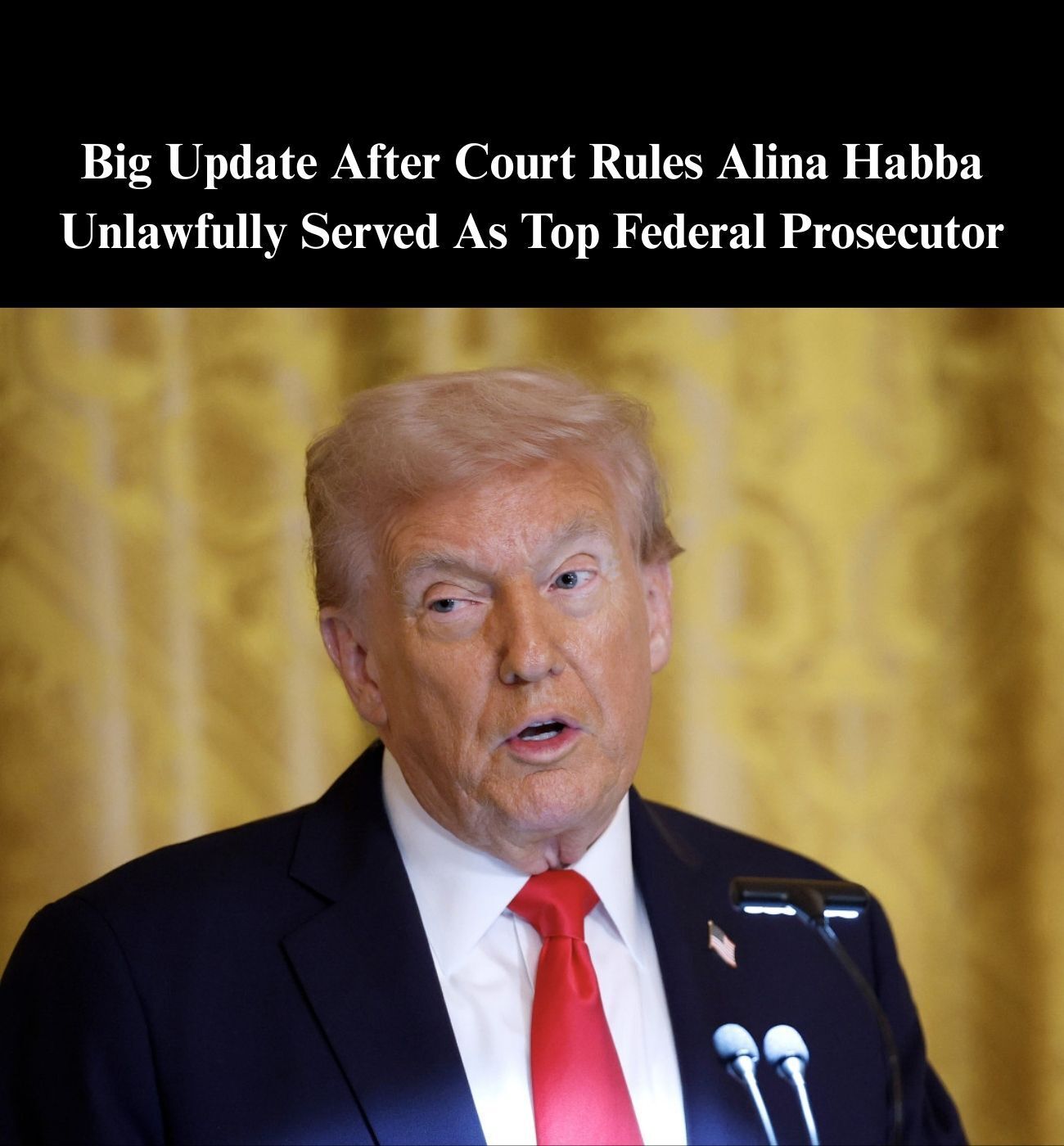
An appellate court ruled on Monday that Alina Habba is illegally serving as New Jersey’s top prosecutor, delivering a blow to President Donald Trump as he fights to keep his preferred nominees in charge of U.S. attorneys’ offices in Blue states.
A three-judge panel of the U.S. Court of Appeals for the 3rd Circuit unanimously concluded that a lower court was right to disqualify Habba, a fierce Trump supporter who used to be the president’s personal defense attorney.
The panel said that the Trump administration’s position would “effectively [allow] anyone to fill the U.S. Attorney role indefinitely.” They also said, “This should raise a red flag.”
The administration may still ask all of the 3rd Circuit judges to look at the ruling again, or it could go all the way to the U.S. Supreme Court for a final ruling.
In October, the three-judge panel heard arguments on Habba’s appointment and asked a DOJ lawyer a lot of questions about how Trump and Attorney General Pam Bondi brought Habba back as U.S. attorney after her first, temporary appointment ended.
Habba is one of many people who got stuck in court because of claims that Trump avoided the Senate and took advantage of gaps in federal vacancy regulations to keep his favorite prosecutors in place.
The lawsuit against Habba was the furthest advanced in the court system, but Lindsey Halligan and Bill Essayli, who are currently serving as temporary U.S. attorneys in Virginia and California, respectively, are also facing serious legal challenges to their appointments. Last Monday, a federal judge said that Halligan was not legally serving in her position, but the administration has promised to challenge the judgment.
Two people chosen by former President George W. Bush and one chosen by former President Barack Obama made up the panel that heard Habba’s case.
The justices were doubtful of DOJ lawyer Henry Whitaker’s arguments that Bondi had the power to replace the position of U.S. attorney for New Jersey after Trump fired the one who had been designated by the court. Whitaker stated that the government only took use of “overlapping mechanisms” that Congress gave it.
“In this case, the executive branch admittedly took a series of precise and precisely timed steps not to evade or circumvent those mechanisms but rather to be scrupulously careful to comply with them,” Whitaker said.
One of the judges said during the oral arguments that he viewed Habba’s case as unusual and possibly unconstitutional.
“Would you concede that the sequence of events here, and for me, they’re unusual, would you concede that there are serious constitutional implications to your theory here, the government’s theory, which really is a complete circumvention, it seems, of the appointments clause?” the judge asked.
Abbe Lowell, a well-known D.C. lawyer who has worked on cases against the Trump administration, represented the defendants who were fighting Habba’s nomination.
Two groups of defendants with normal offenses brought the case against Habba, alleging she shouldn’t be able to prosecute them since she wasn’t a valid U.S. attorney.
Habba couldn’t get confirmed by the Senate because New Jersey’s Democratic senators, Cory Booker and Andy Kim, didn’t support her through the Senate’s blue slip tradition.
That precedent has angered Trump because Senate Judiciary Committee Chairman Chuck Grassley, R-Iowa, strongly supports blue slips. These slips require home state senators to approve U.S. attorney and district judge nominations.
Trump recently made it clear that he thinks that getting the support of Democratic senators might disqualify someone from being nominated by firing former U.S. Attorney Erik Siebert. This has led to a stalemate in the Senate regarding his choices in blue states.