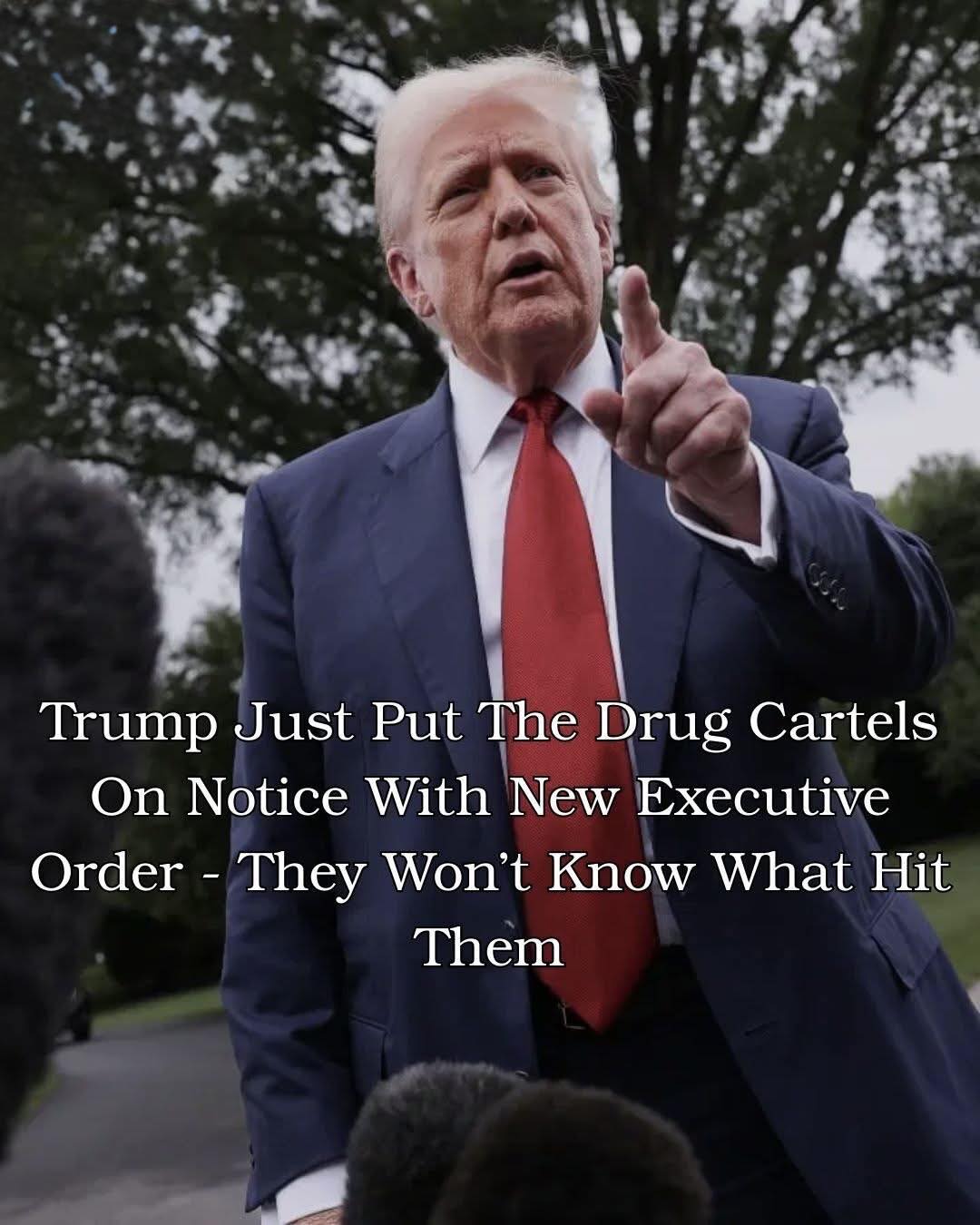
-President Donald Trump sent a clear and unmistakable message to international drug cartels on Monday: the era of treating fentanyl like an ordinary narcotic is over.
In a major escalation of his administration’s long-running war on drugs, Trump signed a sweeping executive order formally classifying illegal fentanyl and its primary precursor chemicals as Weapons of Mass Destruction (WMDs) — a designation that dramatically expands the federal government’s legal and enforcement authority to combat the deadly substance.
The move signals that the administration views fentanyl not merely as a criminal justice issue, but as a national security threat on par with chemical, biological, and radiological weapons.
“No Bomb Does What This Is Doing”
Speaking from the Oval Office before signing the order, Trump made clear why his administration believes such an extraordinary step is warranted.
“Today I am taking one more step to protect Americans from the scourge of deadly fentanyl flooding into our country,” Trump said. “With this historic executive order, we are formally classifying fentanyl as a Weapon of Mass Destruction — which is what it is.”
“No bomb does what this is doing,” he continued. “Two hundred to three hundred thousand people die every year, that we know of.”
While public health agencies often cite lower official figures, the president emphasized that undercounting and delayed reporting obscure the true scope of fentanyl’s devastation across the country.
Why the WMD Designation Matters
Classifying fentanyl as a Weapon of Mass Destruction is not merely symbolic. Under federal law, WMD designation unlocks a broader and more aggressive set of tools for law enforcement, prosecutors, and national security agencies.
According to the White House press release accompanying the executive order, the directive includes several immediate actions:
- The Attorney General is instructed to aggressively pursue criminal charges, sentencing enhancements, and sentencing variances in fentanyl trafficking cases, allowing prosecutors to seek significantly harsher penalties.
- The Secretary of State and the Secretary of the Treasury are directed to target assets, financial networks, and institutions connected to the manufacture, distribution, and sale of illicit fentanyl.
- Expanded coordination with national security agencies to treat fentanyl trafficking as a transnational threat rather than a routine criminal enterprise.
- Increased pressure on foreign governments tied to the production of precursor chemicals used to manufacture fentanyl.
In practical terms, traffickers may now face penalties typically reserved for terrorists and WMD proliferators — including decades-long sentences and expanded asset forfeiture.
A Shift From Policing to National Security
For years, critics of America’s drug policy have argued that fentanyl is fundamentally different from previous narcotics epidemics. Unlike heroin or cocaine, fentanyl is so potent that even microscopic amounts can be fatal, making it uniquely dangerous not just to users but to first responders, border agents, and law enforcement officers.
By framing fentanyl as a WMD, the Trump administration is formally moving the fight from the realm of traditional law enforcement into national security strategy.
Administration officials argue that this shift reflects reality.
Fentanyl has killed more Americans annually than U.S. combat deaths during many major wars. It has devastated entire communities, hollowed out the workforce, overwhelmed emergency services, and left tens of thousands of children without parents.
From that perspective, the administration says, treating fentanyl as anything less than a weapon is willful blindness.
Cartels Squarely in the Crosshairs
While the executive order does not name specific organizations, its intent is unmistakable: international drug cartels are now being treated as mass-casualty threat actors, not just criminal syndicates.
The designation strengthens the government’s ability to:
- Seize cartel-linked financial assets worldwide
- Pressure foreign banks and intermediaries
- Impose sanctions on individuals and entities facilitating production or transport
- Justify expanded intelligence operations against fentanyl networks
Trump has long argued that cartels exploit weaknesses in U.S. borders and global supply chains with impunity. This order, according to administration officials, is meant to strip them of that advantage.
Supporters Applaud the Move
Supporters of the executive order say it reflects a long-overdue recognition of fentanyl’s true impact.
“This isn’t hyperbole,” said one former federal prosecutor familiar with WMD statutes. “Fentanyl is killing at a scale that rivals weapons used in warfare. Treating it as a national security threat makes legal sense.”
Families affected by overdose deaths have also welcomed the move, arguing that previous policies failed to match the scale of the crisis.
Critics Raise Questions
Critics, however, have raised concerns about potential overreach, questioning whether the WMD designation could lead to unintended consequences in sentencing or enforcement. Others argue that addiction treatment and prevention must remain central to any long-term solution.
The administration has countered that enforcement and treatment are not mutually exclusive — and that stopping the supply of fentanyl is a prerequisite for any meaningful progress.
A Defining Moment in the Drug War
Whether the executive order withstands legal challenges or reshapes federal policy long-term remains to be seen. But there is no question it marks a dramatic turning point.
By labeling fentanyl a Weapon of Mass Destruction, President Trump has reframed the drug crisis as a direct attack on American lives, not merely a public health failure.
And with that designation, the message to drug cartels is unmistakable:
The rules have changed — and the consequences just got far more severe.