Donald Trump’s latest diplomatic message has triggered a political firestorm in Washington, reviving one of the most extreme constitutional mechanisms ever written into U.S. law: the 25th Amendment. What began as an unconventional and provocative message to a foreign leader has now escalated into a serious debate among lawmakers, legal scholars, and party leaders over presidential fitness, executive power, and the limits of political tolerance in a deeply polarized era.
The controversy centers on a message Trump reportedly sent to the Norwegian prime minister, Jonas Gahr Støre, in which he expressed anger over not receiving the Nobel Peace Prize and tied that grievance to aggressive rhetoric about U.S. global posture. In the message, Trump appeared to conflate Norway’s role with that of the Nobel Committee, while also reiterating past claims that the United States must assert “complete and total control” over Greenland for national security reasons. He did not rule out the use of military force, language that immediately alarmed U.S. allies and lawmakers on both sides of the Atlantic.
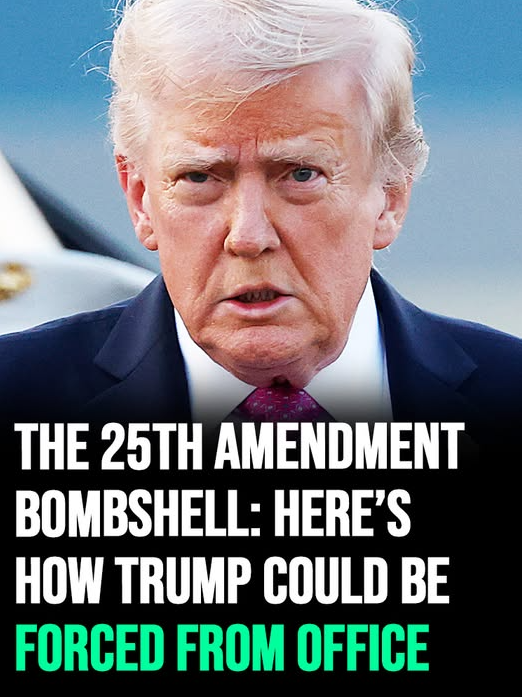
For many Democrats, this communication was not just another example of Trump’s confrontational style. They described it as a tipping point, arguing that it reflected impaired judgment with potentially catastrophic consequences. Within days, calls began circulating in Congress to explore invoking the 25th Amendment as a means of removing Trump from office.
The amendment, ratified in 1967 in the wake of President John F. Kennedy’s assassination, was designed to address situations in which a president is unable to perform the duties of the office due to death, resignation, or incapacitation. It contains four sections, most of which deal with clear and uncontested transitions of power. The section now under discussion—Section 4—is the most controversial and has never been successfully used to remove a sitting president against their will.
Under Section 4, the vice president and a majority of the Cabinet may declare in writing that the president is “unable to discharge the powers and duties” of the office. Once that declaration is delivered to congressional leadership, the vice president immediately becomes acting president. If the president disputes the claim, Congress must intervene, and only a two-thirds vote in both the House and the Senate can keep the president sidelined.
In practical terms, this sets an extraordinarily high bar. It requires not only the vice president’s cooperation, but also broad agreement among Cabinet members and overwhelming bipartisan support in Congress. Still, the fact that lawmakers are openly discussing it underscores how volatile the political climate has become.
Several Democratic officials have been explicit in their concerns. Representative Yassamin Ansari described Trump as “extremely mentally ill” and accused him of endangering lives through erratic decision-making. Other Democrats echoed the sentiment, arguing that Trump’s fixation on personal slights, combined with his willingness to threaten force against allies, demonstrates a level of instability incompatible with the presidency.
Notably, criticism has not been limited to Democrats. A handful of Republicans, including Representative Don Bacon and Senator Mitch McConnell, have publicly expressed discomfort with Trump’s rhetoric and behavior, even if they stop short of endorsing the 25th Amendment. Their comments suggest a growing unease within the party, particularly among lawmakers concerned about national security and international credibility.
At the center of the storm is Donald Trump, a figure who has always thrived on confrontation and spectacle. Trump’s defenders argue that his language, while provocative, is political theater rather than evidence of incapacity. They point out that voters were well aware of his temperament when they returned him to office, and that disagreements over policy or tone do not meet the constitutional standard for removal.
Legal experts largely agree that invoking the 25th Amendment in this context would face serious obstacles. Mark Graber, a constitutional law professor at the University of Maryland, has explained that the amendment was designed for clear cases of medical or physical incapacity, such as unconsciousness or severe cognitive impairment. While it is theoretically possible to apply it to mental incapacity, Graber argues that Trump’s behavior—however controversial—does not meet the legal threshold envisioned by the framers.
Graber and others emphasize a crucial distinction: political unsuitability is not the same as constitutional incapacity. A president may be reckless, offensive, or even dangerous in the eyes of critics, yet still legally capable of performing the duties of the office. That is why, many scholars argue, impeachment remains the proper constitutional mechanism for addressing alleged misconduct or abuse of power, even though it carries its own political hurdles.
Trump’s supporters have seized on this analysis, framing the 25th Amendment discussion as an attempt to overturn an election result by extraordinary means. They argue that labeling political opponents as mentally unfit sets a dangerous precedent, one that could be weaponized against future presidents whenever partisan tensions run high.
Internationally, the episode has already had consequences. Trump’s remarks about Greenland and NATO obligations have unsettled European leaders, who worry about the reliability of U.S. commitments. Diplomats privately describe a growing sense of unpredictability in Washington, where personal grievances appear to bleed into foreign policy messaging. Even allies accustomed to Trump’s style have expressed concern that such communications risk miscalculation at a time of heightened global tension.
Inside the White House, there has been no indication that the vice president or Cabinet members are prepared to take the extraordinary step required by Section 4. Without that internal consensus, the 25th Amendment remains more a symbol of outrage than a realistic path forward. Still, its reemergence in public debate reflects a deeper crisis of confidence in American governance.
This moment reveals how fragile the line has become between political disagreement and constitutional confrontation. The framers of the 25th Amendment envisioned rare, extreme circumstances—presidents physically or mentally incapable of functioning. What they did not anticipate was a political environment so polarized that questions of fitness would become routine weapons in partisan conflict.
For now, Trump remains in office, and the machinery of government continues to function. But the debate itself has left a mark. It has exposed the extent to which trust in leadership has eroded, not only among voters but within the political class itself. Whether the 25th Amendment is ever invoked in this case may ultimately matter less than the fact that so many are openly asking whether it should be.
What endures is a deeper reckoning about power, responsibility, and the standards Americans expect from their highest office. In that sense, the controversy is not just about one letter, one amendment, or one president. It is about how a democracy responds when its leaders test the boundaries of patience, credibility, and constitutional norms—and what happens when those boundaries begin to blur.