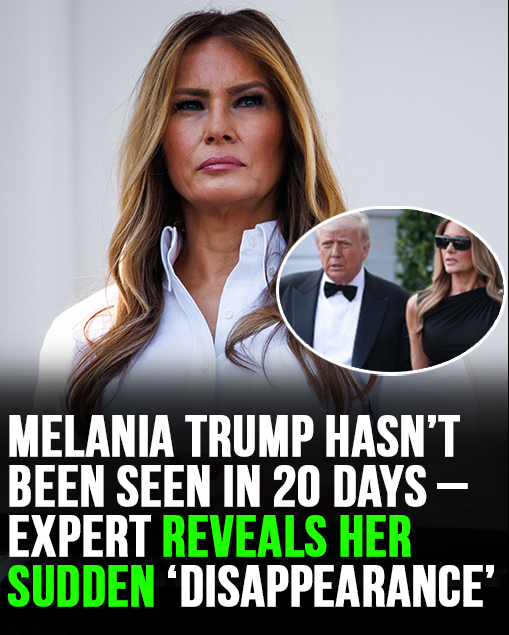
The American presidency has long been described as a “glass house,” a position that subjects its occupants to a level of relentless scrutiny that few human beings ever experience. However, even by the extraordinary standards of the Oval Office, the current climate surrounding Donald Trump has reached a fever pitch. In early 2026, the administration finds itself navigated through a labyrinth of high-stakes geopolitical maneuvers and domestic debates that have turned the White House into a 24-hour news factory. Yet, as the President continues to dominate the airwaves and digital feeds, a conspicuous silence has emerged from the East Wing. Melania Trump, the enigmatic First Lady, has effectively vanished from the public eye for over 20 days, sparking a firestorm of speculation that ranges from political strategy to personal withdrawal.
The backdrop of this disappearance is a period of heightened international tension. Over the past few weeks, President Trump has intensified his focus on the acquisition of Greenland, a topic that originally surfaced during his first term but has now returned as a central pillar of his national security agenda. The administration has argued that U.S. control or strategic ownership of the territory is essential for Arctic dominance and national defense. This renewed push has not been met with open arms; instead, it has triggered a diplomatic earthquake. Officials in Denmark, which has held sovereignty over Greenland since the 19th century, have joined Greenlandic leaders in a firm, collective “no,” stating unequivocally that the territory is not a commodity for sale. European allies have characterized the rhetoric as provocative, leading some domestic critics to even raise the prospect of invoking the 25th Amendment—a move that highlights the growing unease over the President’s unconventional diplomatic style.
In the eye of this political hurricane, the absence of Melania Trump has become a story unto itself. While her husband thrives on the chaos of the news cycle, the First Lady has seemingly opted for a total media blackout. Her last confirmed public appearance alongside the President was during the high-glamour New Year’s Eve celebrations at Mar-a-Lago. Since that night, the only sign of life from her official channels was a brief, digital thank-you message posted on X (formerly Twitter) on January 20th, marking her first year back in the role of First Lady. Beyond that single post, she has remained entirely out of sight, leaving a void that is being filled by intense commentary from political analysts worldwide.
Sigrid Rege Gårdsvoll, a prominent commentator on American politics, has noted that Melania is “conspicuous by her absence.” In her analysis, Gårdsvoll points out that the fundamental difficulty in forming a coherent opinion on Melania as a First Lady stems from her invisibility. Unlike her predecessors, who often used periods of political turmoil to humanize the administration or champion specific social causes, Melania appears to have embraced a policy of total detachment. This withdrawal is particularly striking given the intensity of the Greenland controversy and the domestic backlash currently facing her husband.
However, not all experts believe this absence is a sign of crisis. Eirik Løkke, a specialist in U.S. politics and an advisor to the think tank Civita, argues that Melania’s low profile is not a reaction to current events, but rather a consistent execution of her long-standing personal brand. Løkke suggests that she has never had an interest in the traditional “public servant” role of a First Lady. Throughout the 2024 campaign, she was notably less visible than the spouses of other presidential candidates, signaling early on that her second tenure in the White House would be defined by her own terms of engagement.
“She does not want to take on a public role; she prefers to stay in the background,” Løkke observed. He further hypothesized that her absence might be a calculated effort to avoid being overshadowed by the President’s massive media presence. In the current environment, where Donald Trump’s rhetoric on Greenland and international policy dominates every headline, there is little room for a secondary narrative. Løkke suggests that the President himself may prefer a singular spotlight, and Melania is more than happy to concede it to him. “Everything pales in comparison to Donald Trump and how he is as president,” Løkke stated, implying that the First Lady’s withdrawal may be the most harmonious path for their unique partnership.
This pattern of selective engagement was a hallmark of her first term as well. Between 2017 and 2021, Melania Trump curated a presence that was both highly polished and deeply guarded. She would appear for major state functions, international summits, and holiday events, but she largely avoided the day-to-day political discourse that typically involves the First Lady. When she did speak, it was often through carefully controlled statements or specific initiatives like “Be Best,” which focused on children’s well-being and cyberbullying. Now, in 2026, it seems she has refined this strategy even further, moving from selective visibility to near-total reclusiveness during times of heightened tension.
The contrast between the President’s boisterous, headline-grabbing persona and Melania’s stoic silence has become one of the defining features of the administration. While Donald Trump navigates the fallout of his Greenland comments and staves off critics within his own party, Melania’s absence acts as a sort of quiet buffer. For supporters, her privacy is a sign of dignity and a refusal to be dragged into the “muck” of partisan politics. For critics, it is a dereliction of the ceremonial and social duties expected of her position.
As the administration continues to push forward with its Arctic initiatives and other controversial policies, the question remains: how long can the First Lady remain out of sight before her absence becomes a political liability? Historically, the American public expects a certain degree of visibility from the First Family, particularly when the nation is embroiled in international disputes. Whether Melania Trump will return to the stage to offer a softening presence or continue her withdrawal into the private quarters of the White House is a point of ongoing fascination.
Ultimately, Melania Trump’s 20-day disappearance is a microcosm of her entire approach to public life. It is an exercise in autonomy—a statement that she will not be moved by the expectations of the press or the demands of the political moment. Whether this is a calculated political strategy designed to protect her own brand, or simply the personal preference of a woman who never sought the spotlight, it remains open to interpretation. In an administration defined by loud proclamations and constant motion, Melania’s silence is perhaps the most intriguing statement of all.