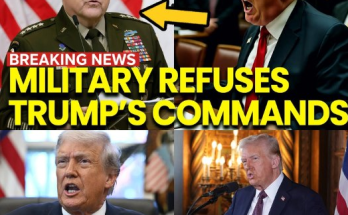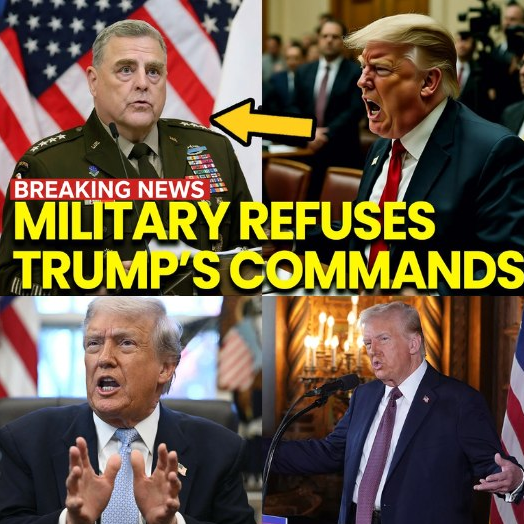
Where does the true power of a President lie? It is not in social media posts, nor in fiery threats from the Oval Office. It lies in whether those who carry the weapons obey his commands. Currently, a seismic shift is rocking Washington as the U.S. military—from high-ranking generals to active-duty soldiers—is publicly sending a message: They will refuse Donald Trump’s unlawful orders.
1. The Spark: A Video from Democratic Lawmakers
In November 2025, six Democratic lawmakers—all with military or intelligence backgrounds—released a viral video. Their message was direct: “You can and must refuse illegal orders”.
Trump’s Fierce Reaction: On Truth Social, Trump labeled this behavior as “sedition” and demanded the death penalty for these lawmakers.
The Heart of the Issue: The lawmakers were not calling for a coup; they were reminding service members of their oath to defend the Constitution rather than maintaining blind loyalty to an individual.
2. Publicly Drawn “Red Lines”
For the first time in modern history, resistance is no longer happening quietly behind closed doors. it is being brought to light through congressional hearings and soldier surveys.
The Generals’ Oath: In a January 2026 hearing, when asked by Senator Elizabeth Warren if he would refuse an order from Trump if it were deemed illegal, a senior general answered firmly: “Yes, I would follow the law”.
The Soldiers’ Stance: Surveys indicate that troops are mentally preparing to refuse orders such as firing on American protesters, conducting mass deportations, or using military force domestically without a legal basis.
3. Controversial Plans: From Venezuela to the U.S. Interior
Concerns over illegal orders are not unfounded when looking at Trump’s increasingly extreme statements:
Ambitions to Invade Venezuela: Trump has spoken of taking control of oil and toppling the Venezuelan government without Congressional approval. Legal experts warn this constitutes an illegal act of aggression.
Domestic Militarization: Plans to deploy the National Guard to suppress protesters or deport immigrants are running into barriers from the Posse Comitatus Act, which strictly prohibits federal military forces from domestic law enforcement.
4. Implications: A Government in “Name Only”?
Trump’s “strongman” brand depends on the assumption that the military will instantly carry out his every whim. When that assumption collapses, his power vanishes.
The Fracture of Authority: A President without the support of the military is merely “a guy yelling from the White House”.
Risk of a Constitutional Crisis: If Trump attempts to fire commanders who refuse orders to find more loyal ones, he will face a deep-seated system of military lawyers and a culture of the rule of law.
Conclusion: When the Constitution Prevails
This confrontation is not a military coup; on the contrary, it is an affirmation of the principle that no one is above the law. The U.S. military is drawing clear lines to protect the very democracy they swore to defend.
Donald Trump may still hold the title of President, but if the most powerful instrument of authority—the military—says “No” to autocratic ambitions, his regime of rule through intimidation has effectively come to an end.
🚨 TRUMP ERUPTS as WORLD LEADERS BLAST HIM After INSULT 🌍🔥 0002
The world is witnessing a phenomenon unprecedented in modern history: heads of state, from the closest allies to long-standing rivals, are collectively and publicly criticizing and rebuking a sitting U.S. President. In his quest to assert absolute power, Donald Trump appears to be inadvertently pushing the United States into a state of isolation never before seen on the geopolitical map.
1. The Rift with “Close Friends”
During a volatile week at the World Economic Forum in Davos, underlying tensions erupted into an open war of words.
Canada and the “Broken” Order: Following Canadian Prime Minister Mark Carney’s speech regarding the “breakdown” of the rules-based international order, Trump immediately rescinded Canada’s invitation to his “Peace Council”. The message from Canada was clear: The world order once led by the U.S. is fading under Trump’s management.
The UK – A Damaged “Special Relationship”: British Prime Minister Keir Starmer used powerful language, describing Trump’s comments regarding the sacrifices of British soldiers in Afghanistan as “insulting” and “appalling”. A British Prime Minister demanding an apology from a U.S. President is a seismic diplomatic event.
2. The Ambition to “Buy” Greenland and European Resistance
Trump’s efforts to pressure Denmark into a takeover of Greenland turned him into a subject of mockery at international summits.
Economic Coercion: Trump threatened to impose tariffs on any nation supporting Greenland’s right to self-determination. French President Emmanuel Macron directly ridiculed this stance, calling the use of tariffs as leverage for sovereignty issues “unacceptable”.
Reversing the Order: Instead of collaborating, Trump is utilizing economic weaponry to threaten his own security partners, severely eroding trust among NATO members.
3. Withdrawing from Environmental Commitments: America Alone
The decision to withdraw the U.S. from the United Nations Framework Convention on Climate Change and over 60 other environmental agreements has sparked widespread outrage.
Inexplicable Recklessness: European leaders labeled this move as “reckless” and “deeply destructive”. One senior EU official even declared that peace, justice, and cooperation are not among Trump’s priorities.
Loss of Leadership: The U.S. is no longer the leader in the fight against climate change; it is becoming the greatest barrier to collective human effort.
4. The Offensive in Venezuela: From Partner to “Aggressor”
The military offensive in Venezuela and the arrest of President Nicolas Maduro have made Trump a target of criticism across the entire Latin American region.
Collective Condemnation: Not only Russia and China, but even Latin American democracies like Colombia and Chile have vehemently protested. Colombian President Gustavo Petro called it an “attack on the sovereignty of all of Latin America”.
U.S. Weakness: The absence of an international coalition supporting this military action demonstrates that the U.S. is losing its ability to mobilize allies for security objectives.
Conclusion: A World Order Without America?
The most serious consequence is not the angry speeches, but the fact that nations are beginning to plan for a “post-American” world. At Davos, leaders discussed ways to maintain international cooperation without Washington’s participation.
Donald Trump may believe he is making America “great again,” but in the eyes of the rest of the world, he is making America “irrelevant”. Once alternative systems are established, restoring America’s leadership position will be an almost impossible task.