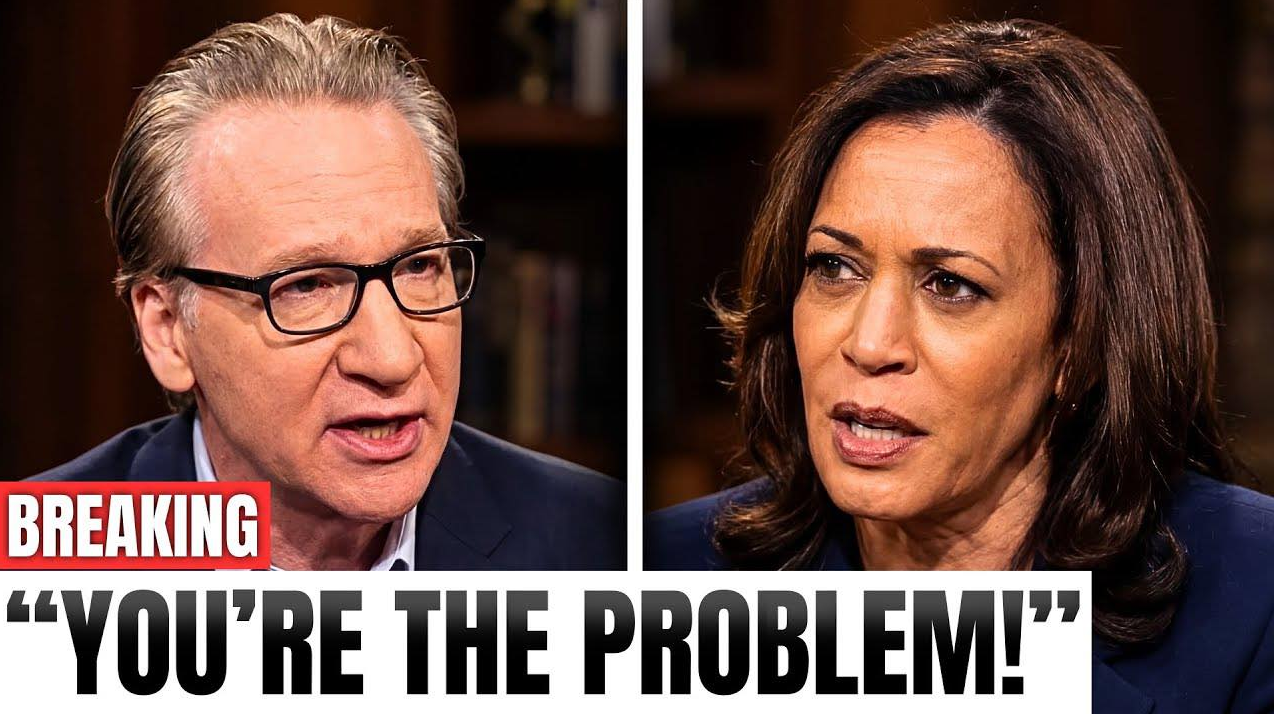
A blistering monologue from Bill Maher has reignited debate across the political spectrum after he delivered a sharp, unsparing critique of Kamala Harris, targeting not just her recent memoir and media appearances, but what he framed as a deeper, systemic problem within the Democratic Party.
Maher’s commentary struck a nerve because it went well beyond personal mockery or partisan sniping. Instead, he treated Harris’s explanations for her stalled political momentum—particularly her claim of having a “short runway” and being constrained by circumstances—as a revealing symptom of a broader cultural and strategic failure. In Maher’s view, the issue was not that Harris faced challenges. It was that she appeared to externalize nearly all responsibility for them.
According to Maher, Harris’s narrative leaned heavily on themes of misfortune, bad timing, and structural resistance, while largely avoiding direct acknowledgment of strategic missteps or personal accountability. He argued that this framing might resonate in activist circles but collapses under scrutiny when presented to voters who expect leaders to demonstrate ownership rather than grievance. In politics, Maher suggested, explanations that sound therapeutic often read as evasive.
One anecdote in particular drew Maher’s scorn: a story from Harris’s book meant to humanize her struggle but which, in his telling, came off as performative and self-indulgent. Maher used it as an example of what he called “cinematic self-pity,” a style of political storytelling that prioritizes emotional validation over clarity or credibility. To him, it wasn’t relatable—it was alienating.
Maher’s critique landed because he contrasted Harris’s narrative with political reality. Democrats, he pointed out, currently enjoy enormous advantages: institutional power, vast fundraising networks, cultural influence, and a massive electorate unified by opposition to Donald Trump. Against that backdrop, claims of helplessness sounded hollow. When a party controls major institutions and commands billions in resources, portraying itself as cornered or silenced risks insulting the intelligence of voters.
He framed this not as a Harris problem alone, but as a party-wide habit. Maher argued that modern Democratic messaging has become obsessed with narrating victimhood, even when holding power. In his view, the party has confused moral righteousness with political effectiveness, assuming that being right automatically translates into being persuasive. That assumption, he warned, is costing Democrats elections.
The heart of Maher’s argument was strategic rather than personal. He emphasized that Democrats are increasingly retreating from uncomfortable spaces—rural communities, conservative media, hostile audiences—and instead choosing to speak almost exclusively to people who already agree with them. This, Maher argued, is not courage. It is insulation.
By refusing to engage Trump voters or address their concerns directly, Democrats are abandoning the most basic rule of democratic politics: show up. Maher dismissed the idea that ignoring or shaming large portions of the electorate is a viable long-term strategy. Politics, he said, is not group therapy. It is not about emotional safety. It is about confrontation, persuasion, and presence.
He warned that saving moral bravery for “safe targets”—corporations, abstract systems, or internal party debates—while avoiding real-world opposition creates the illusion of strength without its substance. Hashtags and applause lines may generate momentary catharsis, but they do not change votes. They do not build coalitions. They do not win elections.
Maher also criticized what he described as the party’s increasing reliance on emotional branding. In his telling, Democrats have leaned into narratives of trauma and grievance not as reflections of reality, but as marketing tools. While those narratives may energize a base, they alienate undecided voters who are less interested in symbolism and more concerned with competence and results.
He argued that voters are not asking for perfection. They are asking for honesty. And honesty, in Maher’s view, begins with acknowledging when strategies fail. Blaming systems, timing, or vague forces instead of reassessing decisions signals insecurity rather than strength.
Maher’s monologue resonated widely because it echoed frustrations already simmering within liberal circles. Even among Democratic voters, there is growing fatigue with messaging that feels self-congratulatory yet ineffective. Many supporters want leaders who can articulate values while also demonstrating tactical realism—leaders willing to enter hostile spaces and risk rejection.
The critique also highlighted a generational and cultural divide. Maher, long positioned as a liberal skeptic, framed himself as someone warning his own side before it’s too late. He did not argue for abandoning progressive values. Instead, he argued for defending them more effectively—by engaging critics directly rather than dismissing them as irredeemable.
In Maher’s framing, the failure is not moral but operational. Democrats, he suggested, have mistaken affirmation for persuasion and outrage for strategy. The result is a party that feels morally certain yet politically stalled.
His comments sparked intense reaction. Supporters praised him for saying what many believe but are hesitant to voice publicly. Critics accused him of being dismissive, out of touch, or unfairly singling out Harris. Yet even among detractors, few denied that the conversation he triggered was uncomfortable precisely because it felt familiar.
Maher closed his critique with a warning rather than a punchline. If Democrats continue to avoid hard conversations, he argued, they will continue to lose ground—not because voters reject their values, but because they reject their approach. Democracy, he insisted, rewards those willing to show up in unfriendly rooms, listen without flinching, and argue without retreating.
The message was clear: power comes with responsibility. When a movement holds influence, resources, and cultural capital, it cannot credibly present itself as powerless. Voters expect leadership, not narration.
Whether one agrees with Maher or not, his monologue cut through the noise because it challenged a comforting story Democrats often tell themselves. It suggested that the problem is not simply external opposition, misinformation, or unfair treatment—but an internal reluctance to confront reality head-on.
In a political climate saturated with outrage and performance, Maher’s critique stood out for its bluntness. It was less about tearing down a single figure and more about demanding that a party serious about governing start acting like it—by trading catharsis for confrontation, emotional safety for strategic risk, and moral certainty for the hard work of persuasion.