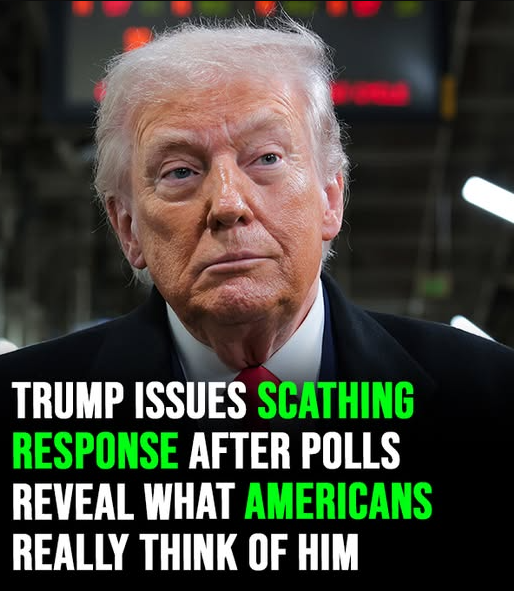
Donald Trump’s relationship with public opinion has once again taken center stage after a series of recent polls painted an unflattering picture of his standing with American voters. The numbers, released by multiple polling organizations over the past several weeks, suggest that the president continues to struggle to secure majority approval as his second term progresses. Trump, for his part, has responded with characteristic force, rejecting the findings outright and accusing pollsters and media outlets of deliberate manipulation.
The latest wave of polling arrives at a delicate moment for the administration. Trump’s return to the White House was marked by confident rhetoric and early claims of renewed momentum, particularly on economic issues. His team has repeatedly pointed to easing inflation, more stable food prices, and what they describe as improving macroeconomic indicators as evidence that his policies are working. Yet those arguments appear to be colliding with voter perceptions shaped by a year defined as much by controversy as by policy.
Trump’s first year back in office has been anything but quiet. His aggressive immigration enforcement strategy has dominated headlines, drawing both praise from supporters and fierce criticism from opponents. At the same time, unresolved questions surrounding the Epstein files, along with a sudden diplomatic flare-up involving Greenland, have added to a sense of constant turbulence. Together, these issues have created an environment in which public opinion appears unsettled and, according to polling data, increasingly skeptical.
One of the most cited surveys comes from a January study conducted by the Associated Press in partnership with the NORC Center for Public Affairs Research. Conducted through January 8, 2026, the poll found that 59 percent of U.S. adults disapprove of the way Trump is handling his job as president, while 40 percent approve. Beyond overall approval, the survey examined attitudes toward specific policy areas that the administration frequently highlights.
On the economy, a central pillar of Trump’s messaging, the results were particularly stark. Only 37 percent of respondents said they approve of his economic performance, compared with 62 percent who expressed disapproval. Immigration, another signature issue, produced nearly identical numbers, with 38 percent approving and 61 percent disapproving. Views on foreign policy and trade negotiations followed the same pattern, each registering 37 percent approval against 61 percent disapproval.
The AP-NORC researchers emphasized that all surveys carry margins of error and that opinions can vary significantly across demographic groups. Still, the broader trend appears difficult to dismiss, especially as similar conclusions have emerged from polling organizations with differing political reputations. A survey conducted by The New York Times in partnership with Siena University placed Trump’s approval rating at roughly 40 percent, with a majority of respondents dissatisfied with both the economy and the overall direction of the country.
Other polls show modest variation but no dramatic reversal. A survey by the The Wall Street Journal put Trump’s approval at 45 percent, while a Reuters poll conducted with Ipsos found approval hovering around 41 percent. An average of national polls compiled by RealClearPolitics currently places Trump’s approval at approximately 42 percent, with about 55 percent of respondents disapproving.
What stands out most clearly is the consistency. Trump’s approval rating dipped below the 50 percent mark last March and has not recovered since. Republican pollster Daron Shaw, speaking on Fox News, noted that while support among Republican voters has remained relatively steady, opposition among Democrats has hardened. That growing partisan divide, he argued, has made it difficult for Trump to improve his overall numbers, even if his base remains loyal.
Trump himself has dismissed the polling data entirely. In a lengthy post on Truth Social, the president accused a wide range of media organizations of publishing what he described as misleading and politically motivated surveys. His criticism was sweeping, targeting not only outlets traditionally viewed as left-leaning but also conservative-leaning organizations that have reported unfavorable numbers.
In the post, Trump repeated long-standing grievances about polling during previous election cycles, including the 2020 race. He claimed that many polls were “knowingly wrong” and designed to shape, rather than measure, public opinion. “Fake and Fraudulent Polling should be, virtually, a criminal offense,” he wrote, arguing that inaccurate surveys undermine democracy by discouraging voters and distorting public discourse.
Trump went further, listing major news organizations and asserting that their polling bore little resemblance to final election outcomes in past contests. According to him, accurate pollsters do exist, but their work is ignored because it fails to support what he calls a biased media narrative. He concluded by describing the current polling environment as a “SCAM” and lamenting what he characterized as the broader decline of American journalism.
The president’s reaction reflects a familiar strategy: confronting unfavorable data head-on while framing it as evidence of institutional hostility. For supporters, this approach reinforces a sense of grievance and solidarity against perceived elites. For critics, it underscores concerns about accountability and the willingness of the administration to engage with empirical evidence.
Whether the polls represent a temporary slump or a deeper challenge remains to be seen. Approval ratings often fluctuate in response to events, economic conditions, and shifting political narratives. With the midterm elections still months away, there is time for numbers to change. However, sustained disapproval across multiple policy areas suggests that the administration faces more than a passing optics problem.
What is clear is that Trump shows no inclination to soften his rhetoric or adjust his response to negative coverage. Instead, he continues to frame polling and media scrutiny as adversarial forces to be resisted rather than signals to be addressed. As the political calendar advances and attention gradually turns toward the midterms, these dynamics are likely to intensify, shaping not only Trump’s public messaging but also the broader national conversation around leadership, trust, and accountability.