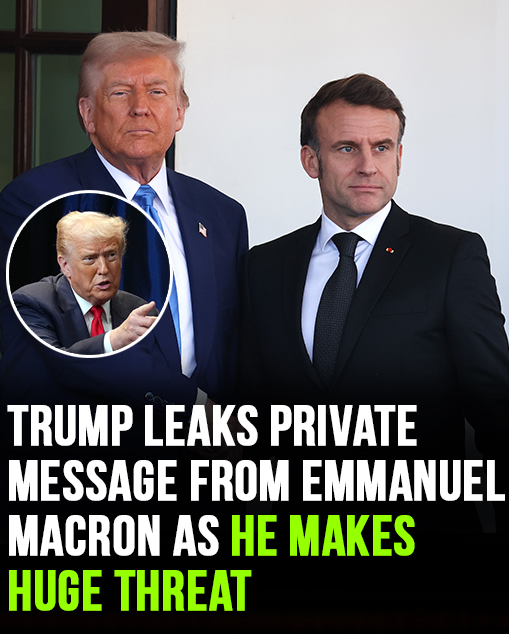
The unwritten code of diplomatic confidentiality was shattered in the early hours of Tuesday morning when President Donald Trump utilized his social media platform to broadcast a private message from French President Emmanuel Macron. The leak, part of a broader series of pre-dawn digital broadsides, marks a stunning escalation in the friction between the White House and its European allies—even for a president whose political brand is built on the public upending of private alliances. The timing of the disclosure coincides with the World Economic Forum in Davos, a summit where the global community traditionally seeks de-escalation. Instead, the reveal has underscored a deepening chasm within NATO as President Trump continues to press for the acquisition of Greenland, a demand that has left the international community oscillating between bafflement and genuine alarm.
The “Art” of the Leak
Diplomatic veterans recognize that navigating the current administration requires a delicate balance of public resolve and private entreaty. Emmanuel Macron, seemingly aware that a blunt “no” rarely yields results with this POTUS, attempted to establish a direct line of dialogue to steer the President toward more conventional geopolitical goals.
The strategy backfired spectacularly. Trump’s decision to publish the screenshot is being viewed as a calculated betrayal of trust, reminiscent of June 2025, when the President disclosed the specifics of a confidential conversation with NATO Secretary General Mark Rutte.
According to the leaked screenshot, Macron’s message was an exercise in high-level diplomacy:
“My friend, We are totally in line on Syria. We can do great things on Iran. I do not understand what you are doing on Greenland. Let us try to build great things: 1) I can set up a G7 meeting after Davos in Paris on Thursday afternoon. I can invite the Ukrainians, the Danish, the Syrians and the Russians in the margins 2) Let us have a dinner together in Paris together on Thursday before you go back to the us. Emmanuel.”
Tariffs, Snubs, and the “Board of Peace”
The friction between Paris and Washington is being fueled by more than just the Arctic dispute. Tensions reached a boiling point after Macron reportedly declined an invitation to join the President’s controversial “Board of Peace”—an initiative that notably includes an invitation to Russian leader Vladimir Putin.
Trump’s response to the snub was characteristic. When informed by a reporter that Macron was likely to reject the appointment, the President retorted: “Did he say that? Well, nobody wants him because he will be out of office very soon.”
He immediately followed the personal slight with an economic threat: “I’ll put a 200% tariff on his wines and champagnes, and he’ll join, but he doesn’t have to join.”
A Fragile Alliance Under Pressure
The President’s “bullishness” over Greenland has now morphed into a broader threat against the European Union. “I may put a tariff on countries if they don’t go along with Greenland, because we need Greenland for national security,” Trump stated, dismissing the collective “kick back” from European leaders.
While world leaders converge in Davos to address a litany of pressing global crises, the dialogue has been hijacked by this unprecedented breach of protocol. The publication of Macron’s private outreach suggests that for the current White House, the value of a “grand show” of strength outweighs the traditional sanctity of diplomatic correspondence.
As the G7 leaders contemplate Macron’s proposed meeting in Paris, the central question remains: can any meaningful diplomacy occur when the President of the United States views private messages as public ammunition?

Does President Trump’s decision to publish private diplomatic messages damage the U.S.’s credibility on the world stage, or is it a transparent approach his supporters find refreshing? Join the discussion in the comments.