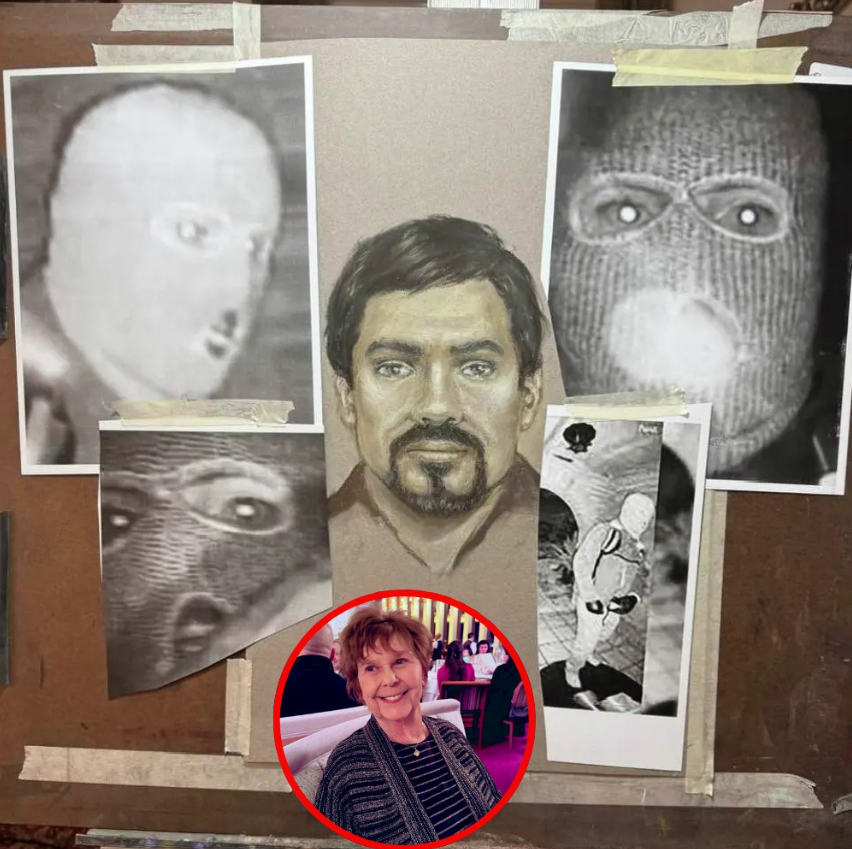
Famed Houston crime sketch artist Lois Gibson has released a new composite drawing in connection with the missing person case of Nancy Guthrie, offering what she describes as a reconstructed facial image of a masked individual captured on a doorbell surveillance camera outside Guthrie’s home.
Gibson, widely known for her decades-long career assisting law enforcement agencies, shared the sketch publicly in a Facebook post. In her statement, she acknowledged the limitations of the available imagery and emphasized that portions of the face were reconstructed based on professional estimation.
“I GUESSED at the parts of face covered with ski mask on this Nancy Guthrie kidnapping suspect,” Gibson wrote. “I used the surveillance photos shown. I spent 43 years at job trying to help detectives with similar photos. Only thing somewhat sure are eyes and part of lips/mustache. I’ll take the hit if I’m drastically wrong. Don’t criticize — do your own version.”
The sketch is based on surveillance stills reportedly captured by a doorbell camera at Guthrie’s residence. The footage allegedly shows an individual wearing a ski mask near the property. Authorities have not publicly confirmed whether the masked individual has been formally identified as a suspect, nor have they provided detailed commentary regarding the video evidence.
Gibson’s decision to release the composite independently has generated significant public interest. Over her 43-year career, she has built a national reputation for assisting detectives in identifying suspects through composite artistry. Her sketches have been credited in multiple criminal investigations, though each case varies depending on the quality of available imagery or eyewitness accounts.
In this instance, Gibson clarified that only the visible features — primarily the eyes and part of the lips or mustache — were drawn directly from the surveillance images. The remainder of the facial structure was inferred based on professional experience and anatomical estimation. She openly acknowledged the speculative component of the reconstruction.
Composite sketches have long been used as investigative tools when photographic clarity is limited. When suspects partially conceal their faces, artists may rely on visible bone structure cues, proportions, and contextual elements to estimate hidden features. However, experts note that such reconstructions are interpretative and not definitive photographic representations.
Law enforcement agencies often caution the public that composite drawings are intended to generate leads rather than serve as conclusive identification. Even in cases where sketches closely resemble individuals later identified, discrepancies are common due to perspective distortion, lighting conditions, and camera resolution.
The doorbell camera technology referenced in the case reflects a broader trend in residential surveillance. Video doorbells have become increasingly common, providing homeowners with digital recordings of visitors and activity near entryways. Such devices often capture short video clips triggered by motion detection. However, image quality can vary depending on lighting, angle, and distance from the lens.
Authorities investigating the disappearance of Nancy Guthrie have not released the full video publicly. It remains unclear whether additional footage beyond the still images used by Gibson exists. Officials have also not confirmed whether the masked individual seen on camera is directly linked to Guthrie’s disappearance.
Public reaction to the sketch has been mixed. Some online commentators praised Gibson’s willingness to contribute her expertise despite acknowledging uncertainty. Others expressed caution about drawing conclusions based on an image reconstructed from limited visual data.
In her statement, Gibson appeared to anticipate criticism, noting that she would accept responsibility if the likeness proved inaccurate. Her invitation for others to “do your own version” underscores the interpretive nature of forensic artistry, particularly when visual references are incomplete.
Forensic art specialists emphasize that sketches can serve as memory aids or conversation starters within investigations. They may prompt recognition from members of the public who believe they have seen someone resembling the composite. However, law enforcement officials typically stress that tips generated by such sketches must be verified through evidence-based procedures.
As of now, authorities have not confirmed whether Gibson’s sketch is being formally incorporated into the investigation. It is also unclear whether investigators consulted with her prior to its release. Law enforcement agencies often collaborate with certified forensic artists during active cases, though independent contributions sometimes emerge in high-profile investigations.
The disappearance of Nancy Guthrie remains under investigation. Officials have provided limited updates regarding potential suspects or persons of interest. The release of the composite sketch introduces a new visual element into public discourse surrounding the case, though its evidentiary role has not been defined.
Experts note that surveillance-based reconstructions differ from traditional eyewitness composites. When artists work from video stills rather than verbal descriptions, they may have more precise visual anchors for certain features. However, when key areas are obscured by clothing such as ski masks, interpretive estimation becomes necessary.
Community members following the case continue to analyze developments closely. The presence of a masked individual near Guthrie’s home, as captured by a doorbell camera, has drawn particular attention. Whether that figure will ultimately prove relevant to the investigation remains to be determined by law enforcement findings.
For now, Gibson’s sketch represents an attempt to visualize what may otherwise remain partially hidden. Her public acknowledgment of the speculative aspects reflects both the limitations and the potential utility of forensic art.
Authorities have encouraged anyone with information related to Nancy Guthrie’s disappearance to contact investigators directly. As the case progresses, additional verified updates may clarify the significance of the surveillance footage and the composite drawing.
Until then, the sketch stands as one interpretation derived from limited imagery — a professional reconstruction offered with transparency about its uncertainties.